The Future of Seo Neo Review: Cloud Link Building For Mac And Pc and Cloud Integration
Current States of Cloud-Based Data Injection in 2026

Automated seo has actually moved beyond simple template filling. In 2026, the focus has shifted towards structure resistant information pipelines that feed directly into web interfaces. This advancement permits for the development of thousands of premium pages that react to real-time changes in market data. Modern workflows depend on cloud-integrated systems that link databases to content generation engines without human intervention for each update. This technique guarantees that info stays fresh, which is a primary ranking consider the existing search environment.
The 2026 technical environment requires more than just static HTML generation. Most advanced operations now utilize serverless functions to deal with inbound data streams. When a data point modifications in a main repository, a trigger fires a reconstruct or a partial update of the pertinent pages. This prevents the crawl errors and outdated information that utilized to plague older programmatic attempts. By focusing on these automated triggers, business preserve an one-upmanship in search results page where accuracy and speed are paramount.
Cloud computing has actually ended up being the foundation of these efforts. Solutions from significant service providers permit for the storage and retrieval of huge datasets that specify specific page variables. These variables might consist of price points, regional schedule, or technical requirements. Managing these at scale requires a clear understanding of how cloud architecture communicates with search engine spiders. Organizations that stop working to sync their cloud storage with their front-end shipment typically see significant drops in presence as search bots prioritize sites that provide immediate, error-free actions.
Automating Seo Neo Review: Cloud Link Building For Mac And Pc for Browse Engines
Constructing a programmatic system begins with a well-structured database. In 2026, the most effective schemas are those that focus on relational information, enabling different pages to pull from shared attributes. For instance, if a specific service is upgraded in one table, every page referencing that service updates instantly. This level of synchronization is essential for preserving brand consistency across a vast digital footprint. Experts in the field often stress that the quality of the information identifies the quality of the SEO efficiency.
Efficient execution of these systems often includes specific tools. Many companies find that investment in Asia Virtual Solutions Review supplies the structure for these automated systems. Without a strong base, the automation risks generating "thin" material that online search engine now punish greatly. The goal in 2026 is to produce programmatic pages that are identical from hand-written content, providing actual value to the user while following the strict technical requirements of contemporary algorithms.
Material generation has actually likewise seen a shift toward semantic importance. Instead of simply repeating keywords, 2026 workflows use LLM-integrated pipelines to manufacture information into legible stories. These engines take raw data points-- like numbers or locations-- and weave them into helpful guides or item descriptions. This makes sure that the programmatic output satisfies the online search engine's desire for useful material. The focus is no longer on the number of pages a system can produce, however the number of of those pages in fact address a user's concern properly.
The Role of Edge Computing in Page Delivery
Speed has actually ended up being a non-negotiable consider search rankings. In 2026, edge computing enables programmatic pages to be produced and served from locations closer to the user. This lowers latency and ensures that even data-heavy pages load in milliseconds. Frameworks that support edge-side rendering have replaced conventional server-side rendering for most large-scale SEO projects. This shift means that the calculation takes place at the network's edge, which is far more efficient for worldwide audiences.
Edge functions can also manage customization without impacting the underlying SEO structure. By examining a user's area or gadget type at the edge, a website can serve a localized version of a programmatic page while keeping the URL and core material consistent for search bots. This balance of user experience and crawlability is a hallmark of successful 2026 digital methods. It enables a level of granularity that was formerly difficult to handle without massive overhead.
Another advantage of edge integration is the ability to deal with traffic spikes. Programmatic websites frequently target trending subjects or localized events, which can lead to unexpected bursts of visitors. Edge-based systems distribute this load throughout an international network, avoiding website crashes that could lead to de-indexing. This strength is a core element of future-proofing any programmatic project. Reliability and uptime are treated as technical SEO signals, straight impacting a site's perceived authority.
Managing Seo Neo Review: Cloud Link Building For Mac And Pc with Automated Quality Control
Quality control is the most significant obstacle when scaling to millions of pages. In 2026, manual review is impossible, so automatic "gatekeeper" scripts are used to scan generated pages for errors before they go live. These scripts check for damaged links, missing images, or ridiculous text strings. If a page fails the check, it is kept in a draft state until the information source or the template is fixed. This avoids a single database mistake from messing up the track record of an entire domain.
Market analysts believe Asia Virtual Solutions SEO NEO Review uses the needed structure for managing countless pages simultaneously. By executing these types of expert requirements, companies prevent the "spam" label that typically impacted early programmatic SEO. The 2026 search bots are highly conscious patterns that suggest low-effort automation. Therefore, the workflows need to include layers of intricacy and variation that mimic human editorial oversight. Range in sentence structure, image positioning, and internal connecting assists programmatic pages pass these rigorous quality tests.
Data cleaning is another critical step in the 2026 workflow. Raw information is hardly ever ready for public intake. It often contains duplicates, formatting mistakes, or outdated facts. Automated cleansing pipelines use maker discovering to normalize data before it enters the material generation stage. This might involve converting units of measurement, remedying spelling in user-submitted information, or validating addresses. The outcome is a refined end product that looks and feels like it was curated by a professional team.
Combination of Semantic Search and Intent Matching
Online search engine in 2026 no longer try to find specific word matches. They try to find intent. This implies programmatic workflows need to be created to cover the whole spectrum of a topic instead of just a single keyword. A workflow may create a cluster of pages that address "how-to" guides, "where-to-buy" lists, and "pros-and-cons" comparisons all from the same set of core information. This topical authority approach is far more reliable at capturing traffic in the existing search environment.
To accomplish this, the design templates used for generation must be extremely flexible. Instead of one rigid design template, developers utilize "component-based" templates. These permit various areas of a page to be switched out based upon the readily available data. If a particular data point is missing out on for one row, the system avoids that element and changes it with another appropriate block. This guarantees that every page is total and functional, regardless of minor gaps in the primary database. It also produces a more varied set of pages that don't look similar to one another.
Internal linking is also dealt with programmatically in 2026. Algorithms identify which pages are most appropriate to one another and develop link structures that assist both users and bots browse the site. This is not practically linking to the home page; it is about producing deep links between associated topics. A page about a specific service might connect to a comparison page, which in turn links to a localized guide. This spider-web of internal links assists disperse "link equity" across the entire site, making sure that even deep-level pages get indexed and ranked.
Future-Proofing Seo Neo Review: Cloud Link Building For Mac And Pc Versus Algorithm Changes
The only constant in search is modification. In 2026, the most successful SEO operators are those who develop modular systems. If an online search engine alters its choice for a particular kind of material or a specific technical tag, a modular system enables the operator to update every page on the site by changing a single piece of code. This dexterity is the meaning of future-proofing. Sites that are built on static, hard-coded pages are quickly left when the industry moves in a brand-new instructions.
The growing requirement for Asia Virtual Solutions for Mac and PC reflects an approach localized data delivery. Online search engine are prioritizing outcomes that feel regional and particular to the user's current context. Programmatic workflows that can ingest local weather condition information, regional financial statistics, or neighborhood events are seeing higher engagement rates. This level of localization requires an advanced API strategy, connecting the web server to various third-party data providers that provide granular, location-based info.
Keeping an eye on efficiency is the last piece of the 2026 puzzle. Automated control panels now track not simply rankings, but user engagement metrics like time-on-page and conversion rates for every produced page. If a group of pages is underperforming, the system can automatically change the design templates or the information inputs to try a different approach. This "self-optimizing" SEO is becoming the standard for massive operations. It turns the site into a living organism that discovers and enhances over time based upon actual efficiency information.
Looking ahead, the integration of cloud computing and SEO will just deepen. The ability to process vast quantities of data in real-time and turn it into practical, indexable content is the essential to visibility in 2026. While the tools and technologies will continue to alter, the underlying principle remains: the most successful programmatic workflows are those that prioritize the user's need for precise, quick, and pertinent information. By developing systems that are both automated and top quality, organizations can ensure their digital existence remains strong for several years to come.
Technical professionals emphasize the value of tidy code and minimal bloat in these automated systems. Online search engine favor pages that load rapidly and are easy for their bots to parse. In 2026, this indicates using modern formats and avoiding heavy scripts that can decrease the rendering procedure. Every millisecond saved in the generation and delivery of a page contributes to its general search performance. As we move deeper into the years, the space between the companies that use these innovative workflows and those that count on manual methods will only continue to widen.

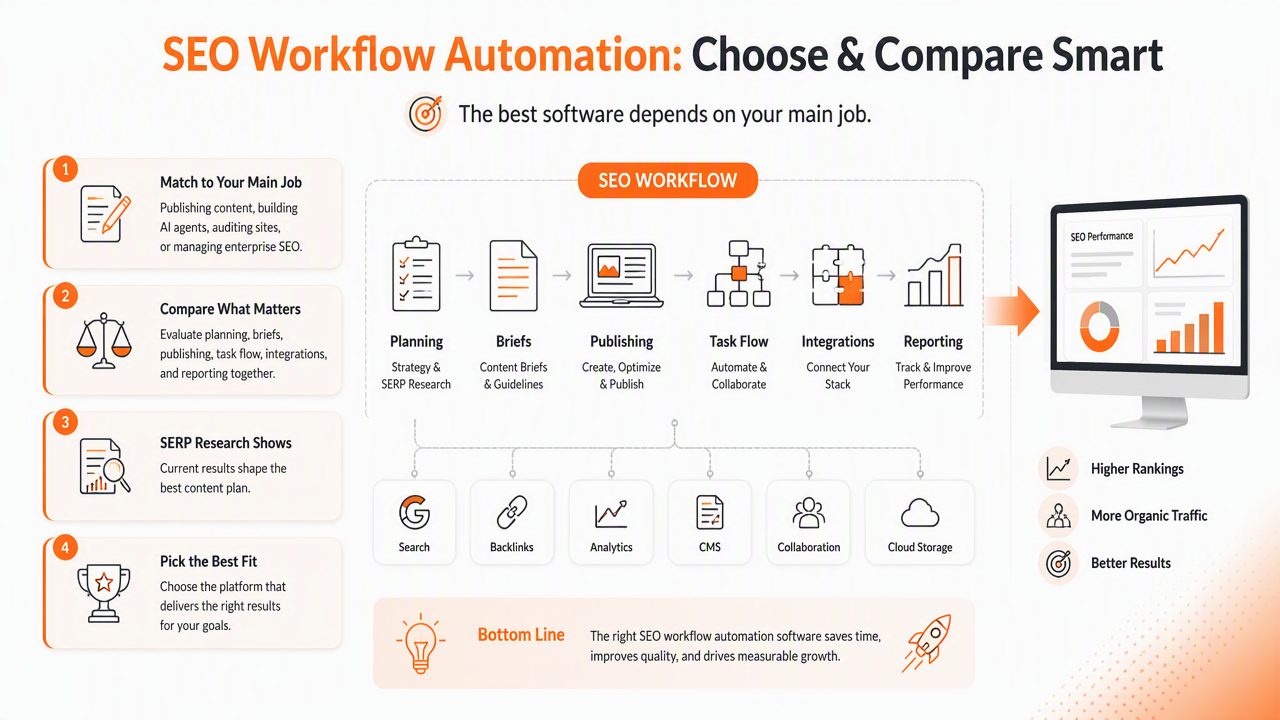


&description=SEO%20automation%20only%20pays%20off%20when%20the%20tool%20matches%20the%20task.%20We%20map%20the%2010%20best%20SEO%20automation%20tools%20of%202026%20to%20the%20specific%20jobs%20they%20take%20off%20your%20plate%20%E2%80%94%20content%2C%20crawls%2C%20rank%20tracking%2C%20reporting%2C%20and%20proof%20of%20revenue.)